
Nexus Darknet

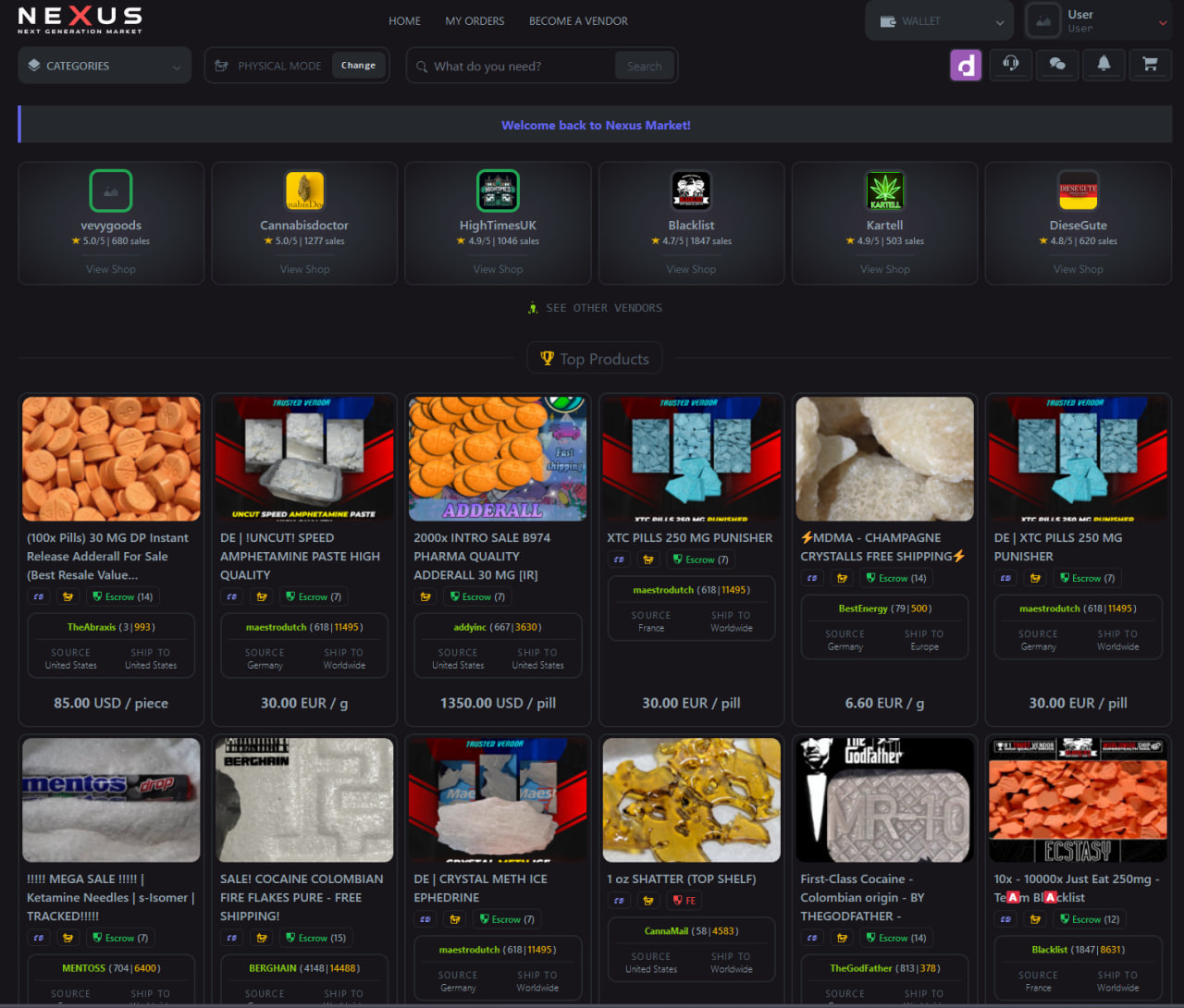
Nexus Darknet emerged in the mid-2020s as one of the most technically sophisticated hidden-service marketplaces catalogued by open-source researchers. Observed through academic publications, court documents, and investigative journalism, the platform distinguished itself through a combination of mandatory Monero settlement, dual-key multi-signature escrow, and a modular vendor-bonding system that created meaningful economic accountability for all participants. This article synthesises publicly available information about Nexus Darknet for research and informational purposes only.
Security researchers monitoring Tor-based commerce infrastructure documented Nexus as maintaining multiple simultaneously active v3 onion entry points, a design that substantially increases resilience against distributed denial-of-service attacks. The platform's operator communications — published as signed PGP messages — indicated an architecture team with demonstrable knowledge of both cryptographic escrow and Tor hidden-service hardening.
Technical Architecture of the Nexus Tor Platform
Documented technical characteristics of the Nexus Tor infrastructure include a full Monero-only payment rail with no Bitcoin fallback option. This design choice simplifies the escrow logic — Monero's subaddress system allows the platform to generate unique per-transaction deposit addresses without revealing any on-chain relationship between them — and aligns with the community consensus that XMR is the appropriate currency for privacy-sensitive transactions.
Researchers noted that Nexus implemented a "finalise-early" (FE) whitelist — a restricted set of high-reputation vendors permitted to release escrow without buyer confirmation. This feature, common on mature platforms, reduces friction for established vendors while maintaining standard escrow for new entrants. The FE whitelist was gated behind a minimum vendor feedback threshold documented as approximately 100 confirmed transactions with a composite score above 4.7 out of 5.
A warrant canary, updated at documented weekly intervals and signed with the platform's primary PGP key, was maintained throughout the observation period in publicly available archives. The canary text followed a standard format specifying that no National Security Letters, secret court orders, or gag orders had been received. Independent key-verification resources confirmed the PGP signature chain was unbroken through the most recent archived canary.
The platform's dispute-resolution system, described in archived operator posts, used a two-stage process: an automated cooling-off window during which buyer and vendor were expected to resolve disputes directly, followed by escalation to a human arbitrator with access to the multi-signature third key. Arbitration outcomes were recorded in a tamper-evident on-chain log, providing a verifiable dispute history for reputation audits.
Three entry-point addresses documented in open-source research allow access through the Tor network. These addresses, recorded in archived forum discussions and academic datasets, are included here as bibliographic identifiers for research cross-referencing, not as access instructions:
The three addresses above represent the primary, secondary, and tertiary entry points as documented in public archives. Researchers use these identifiers to correlate mentions across academic datasets and investigative reports. No access is implied or encouraged.
What Do Researchers Know About Nexus Market Statistics?
Open-source monitoring of darknet commerce platforms, conducted by organisations including DarkOwl and Recorded Future, documented the Nexus Market as sustaining a vendor population in the low thousands during its peak observation windows. Listing counts in public archives ranged from approximately 40,000 to 70,000 active product entries across the platform's primary categories.
Vendor bond requirements documented in archived onboarding communications indicated a refundable XMR deposit equivalent to roughly USD 250–500 at prevailing exchange rates. This bond structure — standard on mature platforms — creates a financial accountability mechanism: vendors who exit without resolving open orders forfeit the bond, partially compensating affected buyers.
Community reputation metrics archived from forum discussions cited a dispute rate below 2%, a figure consistent with platforms that combine mandatory escrow with a mature arbitration system. Researchers note that low dispute rates on darknet platforms correlate strongly with high vendor-reputation requirements and active moderation of low-quality listings.
Operational security researchers studying the Nexus Onion architecture observed that the platform's server infrastructure was distributed across multiple jurisdictions, consistent with the Tor hidden-service threat model. No single takedown event documented in public records was observed to have simultaneously disabled all three entry points.
For information on the cryptocurrency systems used on platforms like Nexus, see the anonymous payment guide. For harm-reduction resources relevant to substances documented on darknet markets, see the harm reduction portal.