
Blackops Darknet

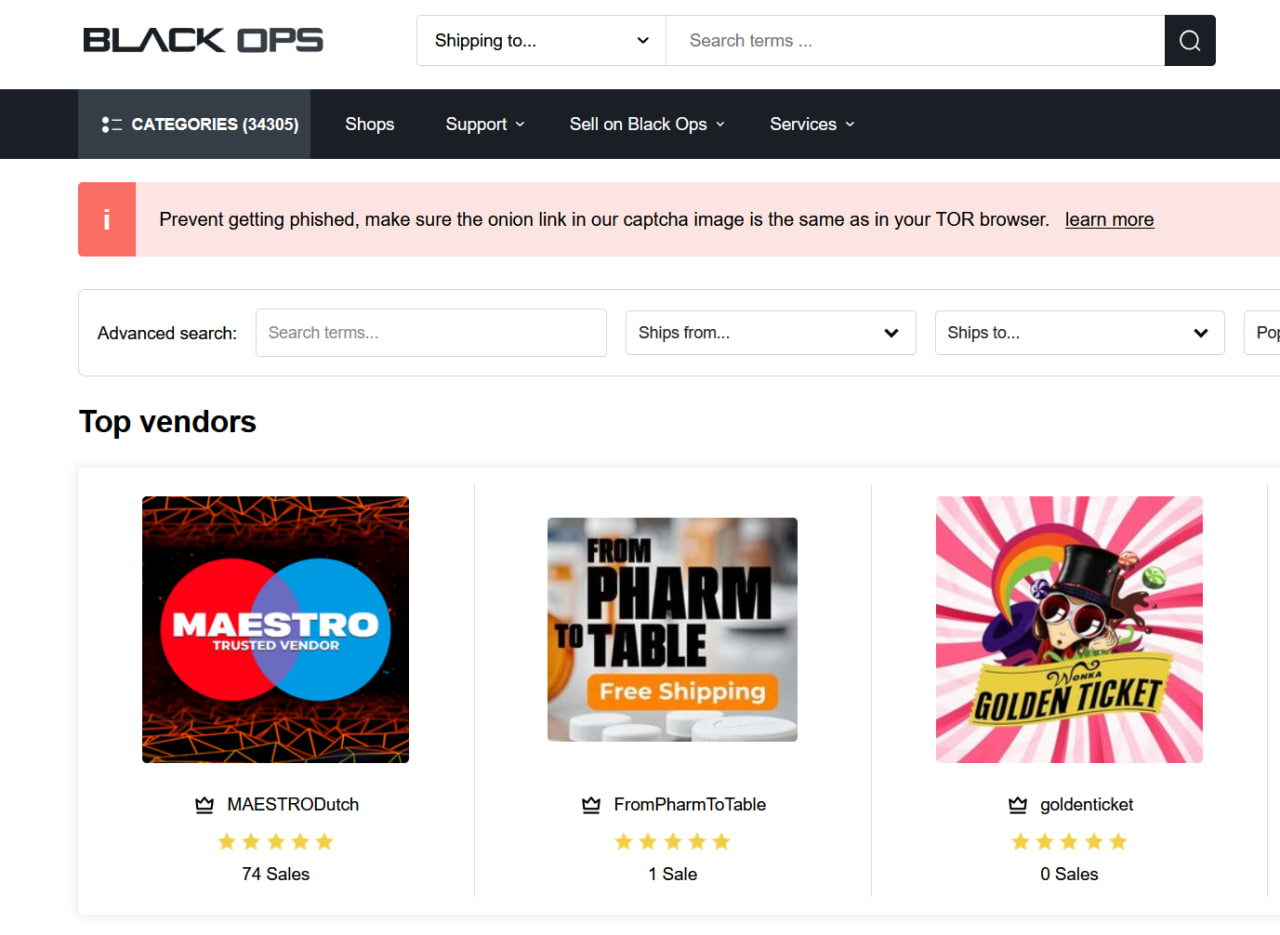
Blackops Darknet is catalogued in open-source intelligence archives as a Tor hidden-service marketplace with particular documentation in cybersecurity-adjacent and digital-goods categories. Research on Blackops Darknet identifies a notable emphasis on non-pharmaceutical listings compared to contemporaneous competitors, with archived category structures showing digital goods, account credentials, and cybersecurity tools as proportionally larger shares of the total catalogue than on typical drug-focused markets.
The platform's single documented v3 onion entry point is recorded in open-source research archives and is presented here for bibliographic reference only. Operator communications archived from darknet forums indicate that the platform actively monitored for phishing clones and published PGP-signed confirmations of its canonical address whenever alternative addresses circulated.
Blackops Darknet Architecture and Category Structure
The Blackops Access model, as documented in archived operator communications, operated on a two-tier vendor permission system. Standard vendors were restricted to a defined category set; verified vendors — a classification requiring additional documentation and a higher XMR bond — could list across all available categories. This tiered approach is documented in research as an attempt to gate access to higher-risk categories behind additional accountability.
Archived listing data from open-source monitoring indicates that the Blackops Darknet marketplace maintained a substantial cybersecurity-tools category including freely available penetration-testing utilities, documentation, and — in some observed snapshots — tools of more ambiguous legality. Researchers studying the platform noted that operator communications drew a stated distinction between tools with legitimate security research applications and tools designed exclusively for offensive operations, though enforcement of this distinction was documented as inconsistent.
The platform's Blackops Mirror strategy documented in public archives relied on community-announced addresses rather than simultaneous multi-endpoint deployment. When the canonical address cycled — a documented practice every 90 days, per archived communications — the update was announced via a PGP-signed post on associated darknet forums, and the previous address's DNS continued resolving for a transition window designed to allow cached bookmarks to update.
The Blackops Onion payment architecture documented in researcher findings used a hybrid approach: Monero for pharmaceutical and physical-goods listings, Bitcoin for digital goods and account transactions. The rationale for the digital-goods exception, cited in operator posts, was that digital-goods transactions carry lower physical-interception risk, and some buyers in that category had established Bitcoin-only workflows. Researchers noted this dual-currency architecture complicated transaction-graph analysis but did not eliminate Bitcoin's inherent transparency for the BTC payment track.
Dispute resolution documentation for the platform describes a vendor-weighted arbitration model — vendors with higher historical completion rates received preferential dispute timelines, giving established sellers a structural advantage in the resolution process. Critics in archived community discussions noted this created perverse incentives for vendors approaching the threshold, while proponents argued it reflected rational reputation-weighting.
For cryptocurrency privacy practices relevant to the Blackops payment infrastructure, see the anonymous payment guide. The operational security guide covers Tor hardening, PGP verification, and the anti-phishing practices that are especially relevant given the documented history of Blackops clone sites.
What Distinguishes Blackops Access from Drug-Focused Markets?
The categorical emphasis of Blackops Access on digital goods and cybersecurity materials distinguishes it from markets whose primary identity centres on pharmaceutical substances. Research datasets from the observation period show digital goods comprising a higher percentage of total listings on Blackops than the industry average — a distribution that aligns with the platform's documented origins in a cybersecurity community forum rather than a general darknet marketplace.
The platform's trust-minimisation approach — two-tier vendor permissions, XMR-preferred escrow, and community-verified address rotation — reflects design choices consistent with a user base that researchers characterised as technically sophisticated. Vendor onboarding documentation references specific OPSEC practices as prerequisites, a gatekeeping mechanism not observed on all comparable platforms.